

Search Uplift Discovery — University of Melbourne
Improving search like a product: clearer intent, higher trust, and a roadmap teams can ship.
Project Overview
The University of Melbourne’s digital estate serves diverse audiences with very different needs — prospective students, current students, researchers, staff, alumni and partners. Search is a critical pathway across all of them, but the experience had become inconsistent and difficult to trust.
I led a structured discovery to diagnose the real causes (not just surface UX symptoms), align stakeholders, and produce an uplift roadmap that balanced fast experience wins with deeper relevance and governance foundations
The Challenge
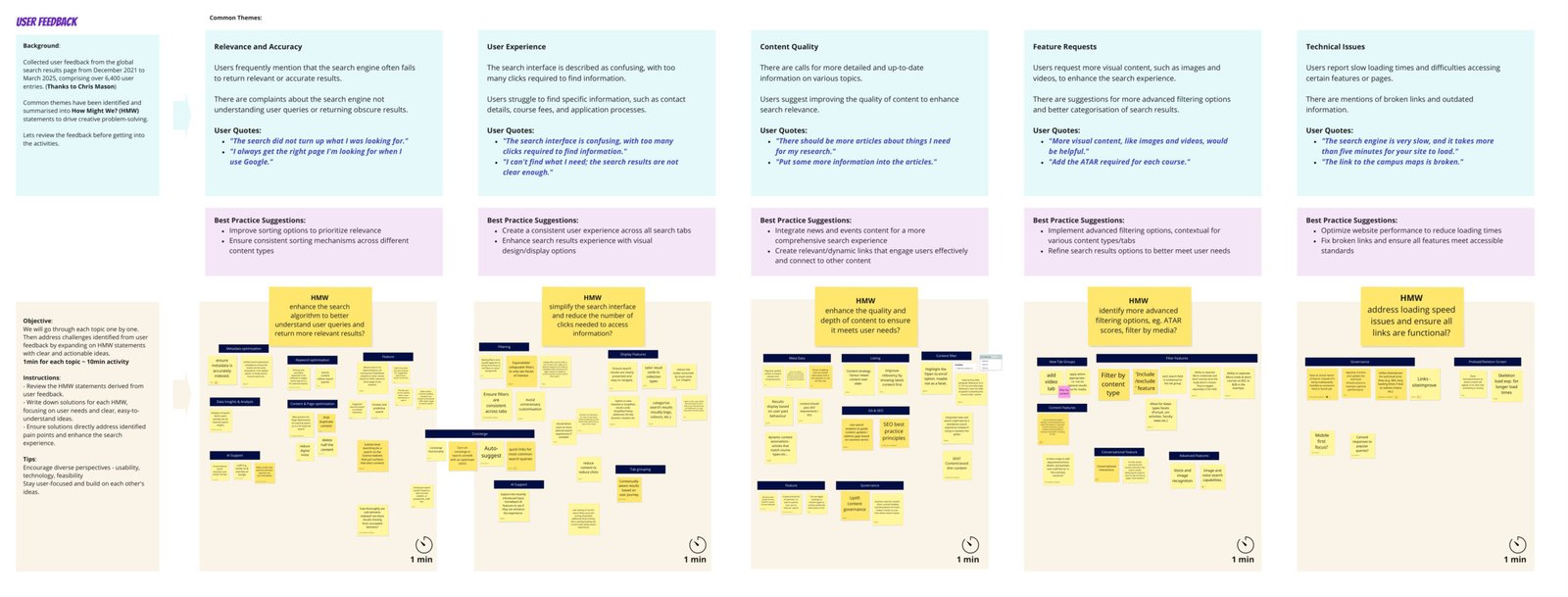
Across user feedback and behavioural signals, a clear pattern emerged: people often couldn’t find what they needed quickly — or they didn’t trust the results enough to commit. Many defaulted to Google when it mattered most.
Common pain points included:
Low confidence in relevance: the “right” result wasn’t reliably near the top.
Fragmented experiences: inconsistent search contexts and behaviours across the ecosystem.
Refinements not earning adoption: tabs and filters existed, but usage beyond “All” was low.
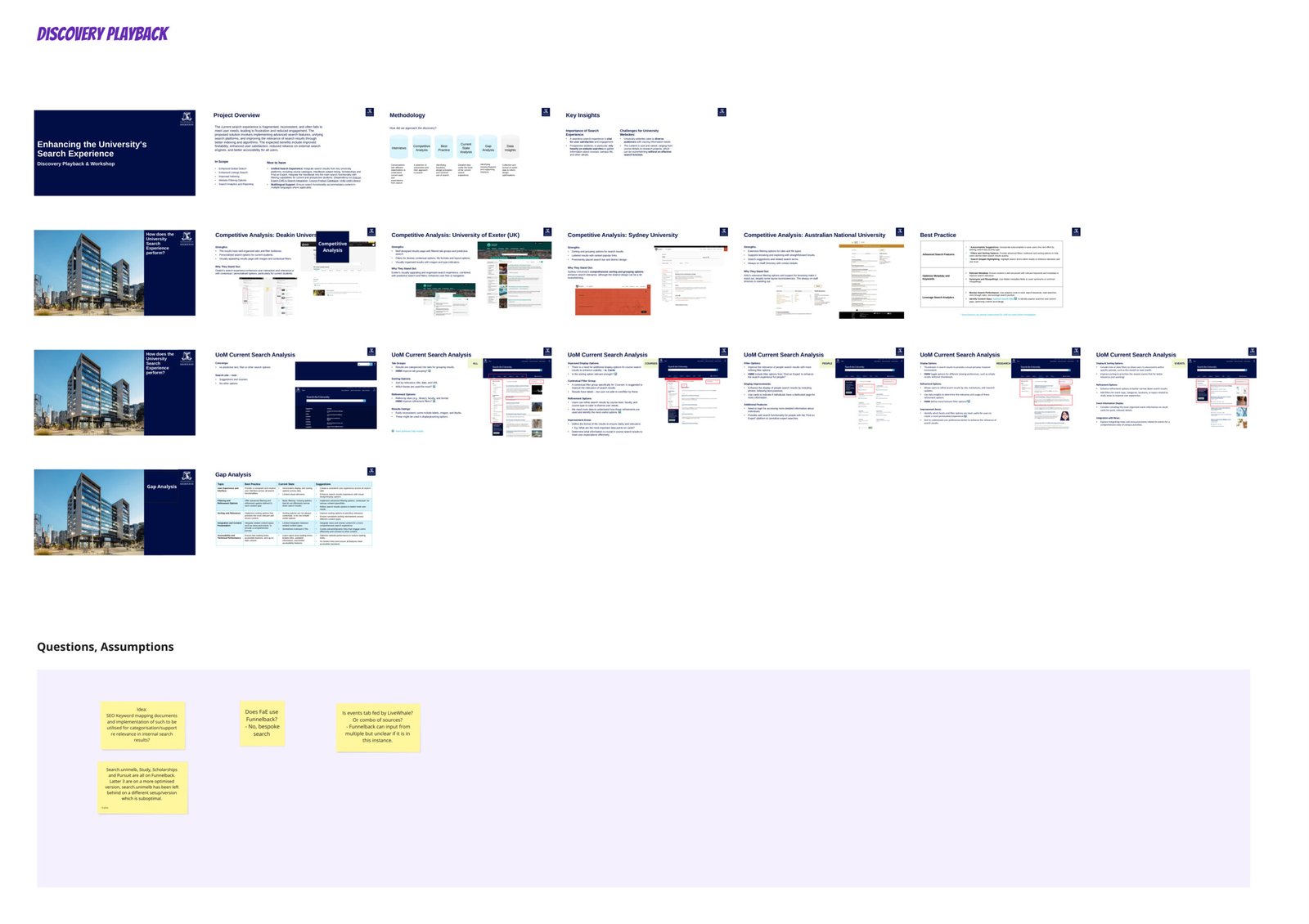
Inconsistent result patterns by content type: Courses, People, Research, Events and Maps behaved differently and weren’t equally useful.
Measurement gaps: limited visibility into “zero-click” searches reduced the ability to tune and improve over time.
My Role
I led the work end-to-end as the product experience designer, with responsibility across discovery, synthesis, stakeholder alignment and delivery-ready recommendations:
Product Experience Lead — framing success measures, diagnosing root causes, shaping the uplift strategy.
Facilitator — running prioritisation workshops and aligning cross-functional stakeholders on what to ship first.
Design Contributor — translating insights into tangible UX recommendations and patterns teams could implement.
Our Approach
I used a structured, evidence-led process so decisions weren’t driven by preference or politics — and so outcomes could move cleanly into delivery.
-
Project framing — define outcomes, success measures, and constraints.
-
Analytics review (Q1 2025) — understand demand, query intent, engagement and drop-offs.
-
User feedback synthesis — analyse ~6,400 feedback entries into themes and “How might we” prompts.
-
Survey snapshot — validate pain points and learn user preferences around results and refinements.
-
Competitive + best-practice benchmarking — confirm proven patterns and identify quick wins.
-
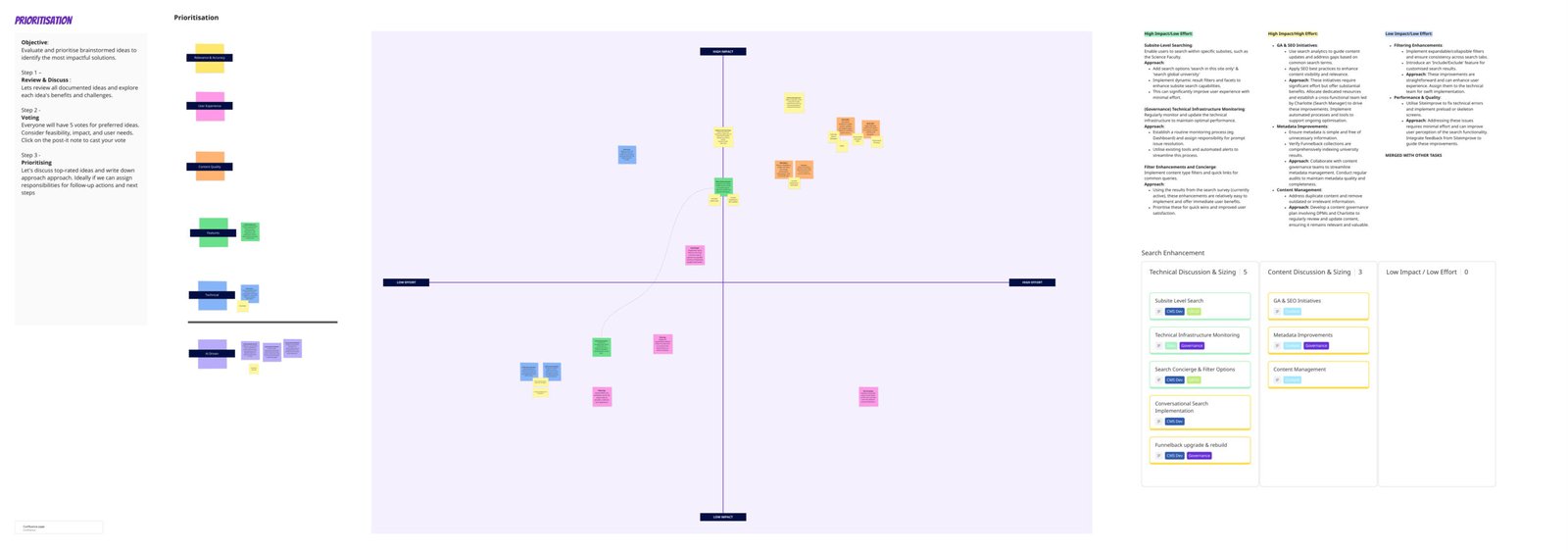
Stakeholder prioritisation workshop — align on an impact vs effort roadmap and delivery slices.
The Solution
The uplift plan balanced immediate UX wins with foundational relevance work — because better UI without better ranking doesn’t stick.
Key recommendations included:
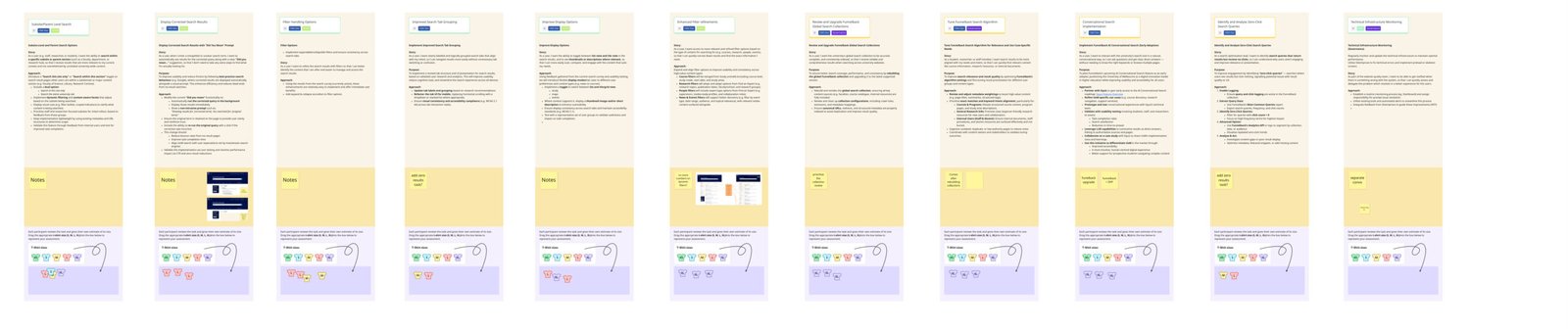
Unify search behaviour — reduce fragmentation and introduce “search within this site/section” where appropriate.
Improve the results experience — clearer tab structure, more scannable results, and filter patterns that reduce cognitive load.
Strengthen specialised content experiences — better refinements for Courses / People / Research / Events / Maps so users can narrow by real decision factors (level, topics, dates, faculty/school, etc.).
Fix relevance at the source — indexing/collection health and ranking signal tuning to lift trust in top results.
Establish a continuous improvement loop — improved measurement (including “zero-click” style signals) and governance/ownership so search keeps improving post-launch.
Explore conversational search (pilot) — assess AI-supported conversational search as a future enhancement for natural-language queries and answer-first experiences.
Implementation plan
To make this actionable, I delivered a prioritised implementation plan (impact vs effort) designed to translate directly into delivery tickets — covering quick wins, sequencing, and dependencies across UX, indexing/relevance, analytics and governance.
Early Outcomes
This work delivered a roadmap teams could act on immediately, with clear rationale and prioritisation:
Shared alignment on what matters most for users and the business.
Delivery-ready recommendations spanning quick wins through strategic platform improvements.
A scalable improvement model — not a one-off uplift, but an approach to keep search performance compounding over time.