
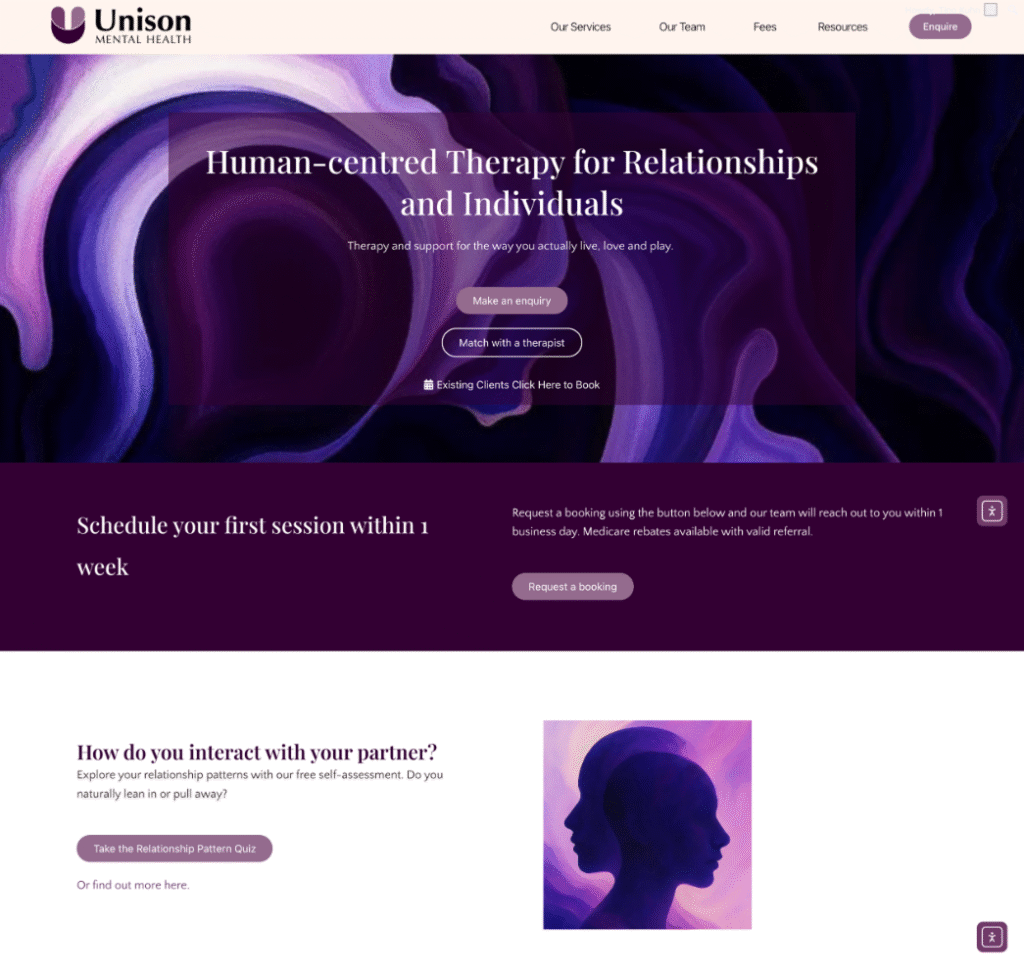
Unison — Turning a mental health practice into a product-led platform
Unison is a modern mental health practice in Melbourne focused on inclusive, relational care. I came in not just to “do a website”, but to build the brand, digital foundations and first products that would let Unison operate more like a platform than a static clinic presence.
The core question running through the work:
How do we turn a small, values-driven practice into a calm, product-like experience where people can actually find the right support — without feeling like they’re in a clinical system?
Understanding the space
Most therapy sites are polite brochures: pastel gradients, headshots, lists of issues treated and a generic contact form. Helpful for ticking boxes, not so helpful when you’re dysregulated, overwhelmed, or trying to find a therapist who actually fits your needs and identity.
At the same time:
People are increasingly comfortable with guided digital journeys, but not with being reduced to a “quiz result”.
Therapists and practices struggle with operations, consent, and data when they try to do anything more advanced than a contact form.
There’s a growing demand for matching, relational tools and inclusive directories, but most solutions are either too clinical, too startup-hype, or too shallow.
Unison sat right in the middle of that tension: a practice with deep relational and trauma-aware expertise, but no digital way to express it beyond a conventional site.
Challenge
How do we design a calm, human digital experience that:
Helps people find the right therapist rather than guess.
Gives couples a gentle, guided way into relational work.
Onboards therapists into a safe, consent-based directory.
And is all still operable by a small practice without a tech team?
Approach
1. Treat the practice as a product ecosystem, not just a site
Mapped audiences and journeys: individuals, couples, therapists, referrers.
Defined where digital tools (not just pages) could genuinely help: matching, assessments, data collection, feedback.
Framed Unison as a platform for experiences: care, matching, and learning.
2. Build a flexible brand, design system and IA
Created the brand, logo, CI and visual language for Unison.
Designed a small but scalable design system (type scale, colours, layout rules, components).
Structured the website IA and page templates around journeys, not org structure.
3. Design and implement the first product layer
Therapair – designed and built a conversational therapist-matching MVP using Typebot + external matching logic.
Pursuer–Withdrawer assessment – created a one-off relational dynamic assessment as a guided conversational flow, not a cold questionnaire.
Therapist directory and onboarding – turned a 200+ therapist CSV into a consent-led directory with a structured onboarding flow.
4. Wire the operational backbone
Set up hosting (Hostinger), email infrastructure and domain routing.
Implemented WordPress/Elementor front end, contact forms and enquiry flows.
Connected Notion databases for therapists, EOIs, research surveys and feedback.
Designed email templates and communication loops for enquiries, follow-ups and therapist journeys.
Outcome
Unison now has a cohesive brand and design system that stretches from marketing site to product experiments.
People can engage through guided experiences (matching, assessments) rather than only static pages.
The practice has a consent-based, structured therapist directory instead of a fragile spreadsheet.
Behind the scenes, a Notion + Typebot + email + WordPress stack gives the team a realistic way to keep experimenting without rebuilding foundations each time.
How I operated (Design / Role)
Across this body of work, my role combined:
Brand & CI — creating Unison’s identity, logo and visual system from scratch.
Experience & product design — website IA, content, flows, Typebot journeys, matching logic framing.
Systems & operations design — hosting setup, email infrastructure, forms, routing and communication loops.
Data & structure — turning a raw 200+ therapist CSV, EOIs and survey data into something usable and safe.
Implementation partner — configuring WordPress/Elementor, wiring Typebot and Notion, and defining how everything fits together so Unison can run it day-to-day.
Why this body of work matters
Patterns that show up here:
Designing service businesses as product ecosystems, not just websites.
Using gentle, conversational UX for sensitive mental health journeys.
Building lightweight, realistic stacks (WordPress, Typebot, Notion, email) that still feel like a product.
Treating data, consent and operations as first-class design problems, not afterthoughts.