
Therapair – Designing a New Therapist-Matching Experience
How Prequel created an inclusive, AI-powered platform that brings empathy, clarity, and trust to mental-health support.
Overview
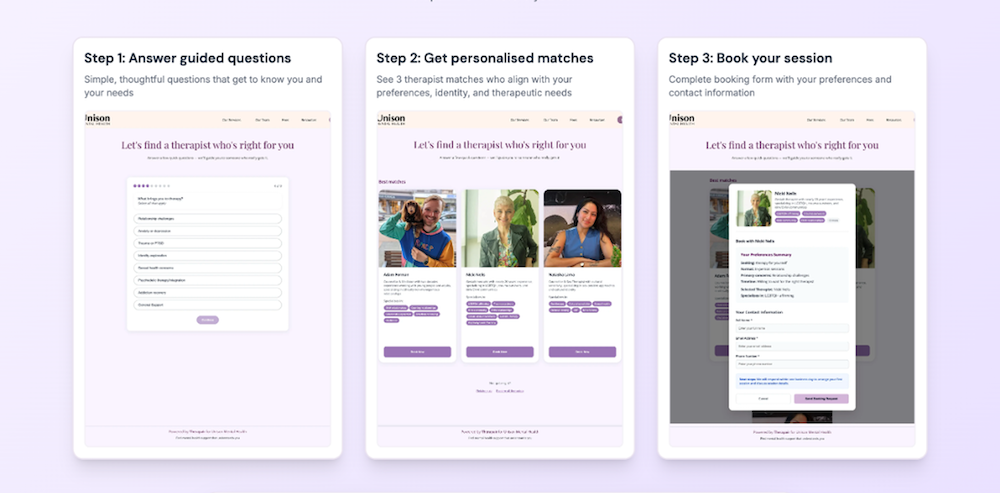
Therapair connects LGBTQI+, neurodivergent, and trauma-informed therapy seekers with practitioners who truly understand them. Prequel partnered with Unison Mental Health to design and ship an MVP: a conversational, privacy-first experience live as both a standalone product and a Unison-branded widget showing only Unison therapists.
Timeline: 6 weeks (Oct 2025) | Partner: Unison Mental Health | Stack: React · Cursor · Claude Code · ChatGPT · Figma Make · Notion API · GitHub · Hostinger
Challenge
Directories often prioritise logistics over people and rely on tracking that erodes trust. Seekers and therapists needed an experience grounded in empathy and privacy.
Key problems
Limited filters for identity and lived experience
Flat, form-based interactions that drive drop-off
Third-party tracking undermining confidentiality
Goal
Design a therapist-matching flow that feels personal, affirming, and safe — scalable for partners and aligned with Therapair’s ethics of inclusion and privacy.
Approach (human-centred, AI-native)
Concept & Validation
Stakeholder interviews with practising therapists and Unison leadership validated the core problem, consent requirements, and tone of voice.
Discovery & Research (with co-design workshop)
We ran a focused co-design workshop (therapists + Unison) to align on user needs, language, and consent boundaries. Outputs included:
End-to-end journey map (discovery → matching → contact/consent → handover)
Consent touchpoints and plain-language microcopy principles
Inclusion filters and accessibility priorities
Risk/assumption log and a prioritised MVP backlog
These artefacts directly informed our strategy-as-prompts for ChatGPT and the component taxonomy in Figma Make.
Design & Prototyping
Early concept test (Typebot): Checked comprehension and friction before high-fidelity work.
Prompt-led design (ChatGPT → Figma Make): We wrote structured design prompts to guide Figma Make output — naming components, defining variants/states, accessibility tokens, microcopy tone (“supportive, plain English”), and mobile-first layout constraints.
Prototype & iterate: Built interactive screens in Figma Make, then re-tested journeys (discovery → matching → consent/contact) and refined copy, spacing, and tap targets.
AI-Native Development
Dev environment (Claude Code in Cursor): Used Claude Code to scaffold a clean React workspace in Cursor (routing, env handling, a11y helpers, form state, Notion/SMTP utilities).
Build the MVP:
Unison therapist widget (embeddable, brand-themed)
Landing page (clear value prop, trust cues, consent-first copy)
Lead capture (minimal fields, one-question-per-screen)
Smart email responses (templated confirmations + therapist handover; no tracking, clear privacy language)
Notion database connections (secure insert/update, basic schema for therapists/enquiries, rate-limited writes)
Source control & deploy (GitHub ↔ Hostinger, coordinated in Cursor):
Cursor orchestrated coding sessions, commit messages, and PR descriptions; Claude Code assisted with diffs and refactors.
GitHub protected branches and PR reviews guarded quality; Hostinger pulled from the main branch or received CI artefacts for deployment.
Secure API keys were injected at deploy via Hostinger environment variables (never committed), with .env in .gitignore, scoped tokens (least-privilege Notion integration, SMTP credentials), and a lightweight rotation note in the runbook.
Documentation: Auth, consent copy, data-handling notes, CI/deploy steps, and an iteration runbook — generated and refined with Claude Code for clarity and consistency.
Design highlights
Conversational prompts (“What brings you to therapy?”) over admin language
One-question-per-screen to reduce cognitive load and drop-off
Warm, minimal interface with accessible contrast and large tap targets
Modular design system enabling quick partner theming (colour, type, components)
How we worked with AI (and why it mattered)
Workshop → prompts: Co-design decisions became structured markdown prompts (goals, constraints, tone, a11y rules).
Prompt → prototype: Figma Make generated coherent components/flows from prompts, accelerating high-quality exploration.
Prototype → production: Claude Code translated patterns into stable React components and utilities inside Cursor.
Coordination: Cursor acted as the “conductor” between local work, GitHub PRs, and Hostinger deployments — keeping changes auditable and fast.
Impact: Shorter loops, more stakeholder time, clearer consent UX, and tighter partner fit — without bloating scope.
Privacy by design
No Google Analytics or marketing pixels
Self-hosted email (Hostinger SMTP)
HTTPS and environment-variable encryption
Partner data stored locally per organisation
Secrets hygiene: tokens kept out of Git; least-privilege scopes; rotation guidance in docs
Consent language front-loaded; no dark patterns
Build & delivery (at a glance)
Repo: GitHub (protected main, feature branches, PR reviews)
CI/CD: Simple build script + Hostinger deploy; status noted in PRs
Secrets: Hostinger env vars; .env not versioned; per-env key sets
Monitoring (lightweight): Health pings and email delivery checks (no tracking/pixels)
Runbook: Release checklist, rollback steps, key rotation procedure
Impact
The MVP shows that AI-native methods and human-centred design can coexist to deliver respectful, emotionally intelligent experiences. It validates Prequel’s Workshop → Prompt → Prototype → Production model as a faster, higher-fidelity path from strategy to shipped product — without compromising empathy or ethics.
Next steps
Broaden user research across Victoria (diverse cohorts)
Refine matching logic and accessibility for wider rollout
Add therapist dashboards and feedback tools
Explore group and relationship therapy pathways
Credits
Concept, Design & Development: Prequel
Partner: Unison Mental Health
AI Tools: ChatGPT (design prompts), Claude Code (Cursor)
Infrastructure: GitHub (source), Hostinger (deploy)
Location: Melbourne, Australia